The first successful summit of the world’s highest mountain, Mt Everest (or Chomolungma, as the Tibetans call her), inextricably linked two people: Sir Edmund Hillary, Order of New Zealand, and Sherpa Tenzing Norgay. The pair were brought together as part of the ninth British expedition to Everest, led by John Hunt.
Breakthroughs in space travel are standard fare for Rocket Lab, the pioneering satellite-launch business started by New Zealand rocket enthusiast Peter Beck in 2006. In 2009, it became the Southern Hemisphere’s first private company to reach space.
Another space pioneer from Aotearoa New Zealand is Sir William Hayward Pickering, Order of New Zealand, the original Rocket Man. His name graced the side of Rocket Lab’s fourth Electron rocket, and their first mission for NASA’s Educational Launch of Nanosatellites programme named: ‘This one’s for Pickering’.
Kupe is the legendary Polynesian navigator who discovered Aotearoa New Zealand. A thousand years ago, he made an epic journey from the eastern Pacific across the ocean to a new land. Kupe is a figure integral to many Māori narratives and histories, and a significant cultural icon.
For over 40 years, Graeme Bydder’s, Companion of the New Zealand Order of Merit, work has been at the forefront of clinical MRI, and has shaped the course of medical diagnosis and improved the lives of countless patients.
Maurice Wilkins, CBE, FRS, was a renowned New Zealand scientist who made significant contributions to the field of molecular biology. Most notably, he was one of the key individuals involved in the discovery and verification of the structure of deoxyribonucleic acid (DNA), the molecule that is the basis for heredity and life.
For over 5,000 Allied soldiers in the fields of France, Belgium and other battlegrounds of World War I, luck was not on their side. Facial injuries – usually gunshot wounds – were all too common, and it fell to a young New Zealand-born surgeon to come up with a way to cope with the often-horrific results.
Alan MacDiarmid’s ground-breaking work in the field of conductive polymers has had a profound impact on the electronics industry and wider society. His research, for which he was awarded a Nobel Prize in Chemistry, has led to the development of a new class of materials with unique properties that are ubiquitous today in many modern technologies.
Richard Pearse was a New Zealand farmer, a renowned inventor, and a trailblazer among the world’s aviation pioneers. He is widely recognised as a leading candidate for the first person to have successfully flown a powered aircraft – although the precise timing of his achievement remains a topic of fierce debate. Richard Pearce’s legacy endures as a testament to his spirit of innovation and serves as an inspiration to all those who aspire to pursue their dreams.
Beatrice Tinsley (née Hill) was born in Chester, England, in 1941, the middle of three daughters born to Jean Morton and Edward Hill. She moved with her family to Christchurch in 1946, after the war. After four years in the South Island, the family moved to New Plymouth in 1950, where her father worked as a clergyman before being elected mayor of New Plymouth from 1953–1956. He subsequently served a term on the New Plymouth Borough Council from 1956–1959.
Jean Batten was a pioneering aviator who gained international recognition for her record-breaking long-distance flights during the early years of aviation. Her fearless determination and exceptional solo flying skills earned her a place among the most celebrated pilots of her time and saw her dubbed the ‘Greta Garbo of the skies’ – a reference to one of the era’s most popular and glamorous movie stars.
New Zealander Fred Hollows, AC, was an internationally renowned eye surgeon and humanitarian who devoted his life to giving back the gift of vision to those who were needlessly blind. He believed that anyone should have the right to quality, affordable eye care and through his efforts, he restored sight to thousands of people around the world and trained other eye doctors to do the same.
When someone once asked Bill Hamilton if he invented the jet boat, the self-taught engineer gave a typically laconic reply: “No, that was Archimedes, and he lived some time ago.”
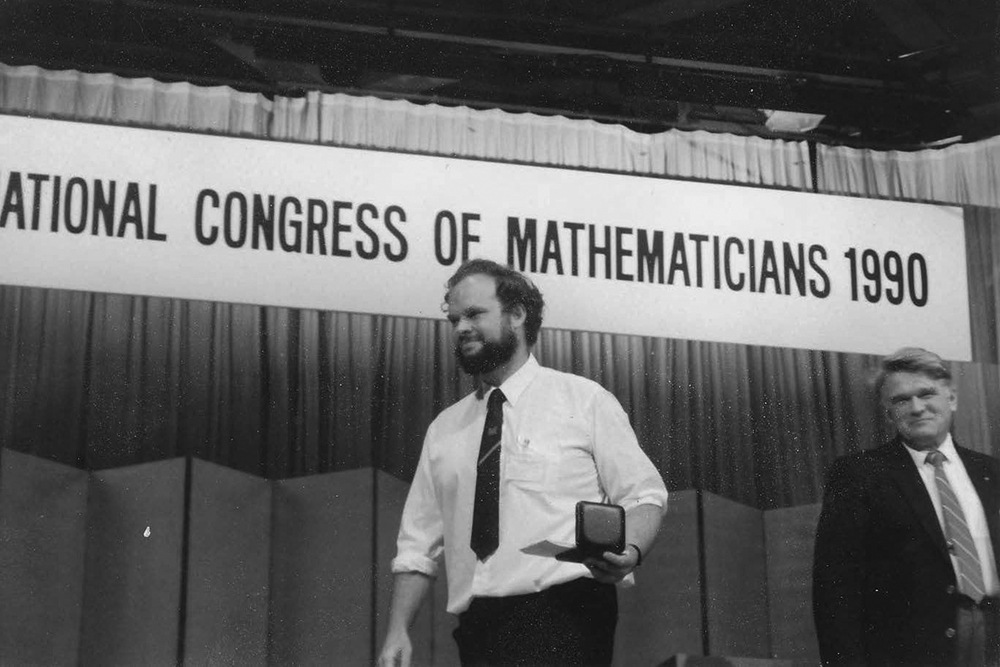
The Fields Medal is often referred to as the Nobel Prize of mathematics. It is awarded only once every four years to up to four mathematicians worldwide, under the age of 40, for significant contributions to the study of mathematics.
Sir Brian Barratt-Boyes was a New Zealand surgeon who played a crucial role in the development of open-heart surgery. His talent and use of ingenuity saw him overcome numerous challenges in the field and led to the development of techniques that have set the standard for others to follow. His work has saved countless lives and cemented him as one of New Zealand’s most inspiring pioneers.
It’s hard to overstate the number of lives saved by Colin Murdoch, New Zealand Order of Merit – is it millions, tens of millions, hundreds? In 1952, inspired by the design of his fountain pen, this polyglot inventor scribbled down an idea for a cheap, disposable syringe that could deliver medicine, especially vaccines, to millions of people without the threat of cross-contamination.
If there was ever a life cut cruelly short, it was that of Peter Blake: sailor, adventurer, environmentalist, and national icon. Just 53 when he was shot and killed by Brazilian pirates in 2001, Peter won many of the ultimate prizes in ocean sailing, raced around the world five times and won the adoration of a nation.
One of New Zealand’s greatest contributions to the world of agriculture came with the combination of two quite different technologies – fencing and electricity. Imagine a fence that did not rely on sheer strength for its effectiveness. This allows the fence to be light, and therefore easily portable. And a portable fence, easily moved around the farm, opens the way to revolutionise agriculture with brand-new grazing practices.
In about 400 BC, the Greeks conjectured that the world was made up of tiny particles, invisible to the eye. Different combinations of these particles gave rise to the vastly different materials that we see around us in the world. They called these particles ‘atoms’ – the Greek word for ‘indivisible’.
AJ Hackett, Officer of the New Zealand Order of Merit, and Henry van Asch, Officer of the New Zealand Order of Merit, are two adventurers that epitomise New Zealand’s spirit of innovation and eagerness to push the limits of what is possible. They achieved worldwide recognition by pioneering the world’s first commercial bungy jump operation in Queenstown, setting the stage for the town to become one of the world’s best adventure tourism destinations.