


Modern Māori Architecture: Celebrating Form, Function and Whakapapa
A new wave of Māori design is carrying ancestral knowledge into the present with innovation, beauty and cultural depth. From reimagined wharenui (traditional meeting houses) to cutting-edge cultural centres, contemporary Māori architecture continues a legacy of indigenous design that’s connected to land, people and purpose.
Today, that legacy is evolving in response to urban contexts, diverse identities and new materials, while staying anchored in mātauranga Māori (Māori knowledge systems).
These buildings do more than serve a function. They hold stories, affirm identity and welcome both tangata whenua (Māori communities) and manuhiri (visitors) with open arms.
Here are four examples of Māori architecture showing how ancestral thinking continues to shape the spaces we live, gather, and learn, in Aotearoa New Zealand.
Ngā Mokopuna, Victoria University of Wellington
You’ll find Ngā Mokopuna in the marae complex at Te Herenga Waka—Victoria University of Wellington. Opened in 2024, it is a transformative learning and teaching space that fosters Indigenous language and innovation. Designed by Tennent Brown Architects, the building was created with input from local iwi and university leadership.
Its form draws inspiration from the wharenui (meeting house), creating a space that aims to feel both like a home and a place of learning. Inside, timber panelling, carvings and artwork reflect the whakapapa (ancestry) of the local area and beyond. A rongoā (traditional medicine) garden sits adjacent to the marae ātea . Built to meet the Living Building Challenge®, the centre is designed to be fully self-sufficient—generating its own energy, harvesting water and managing all waste on site. It’s a space where language, culture and sustainability thrive together.
Wharenui Harikoa
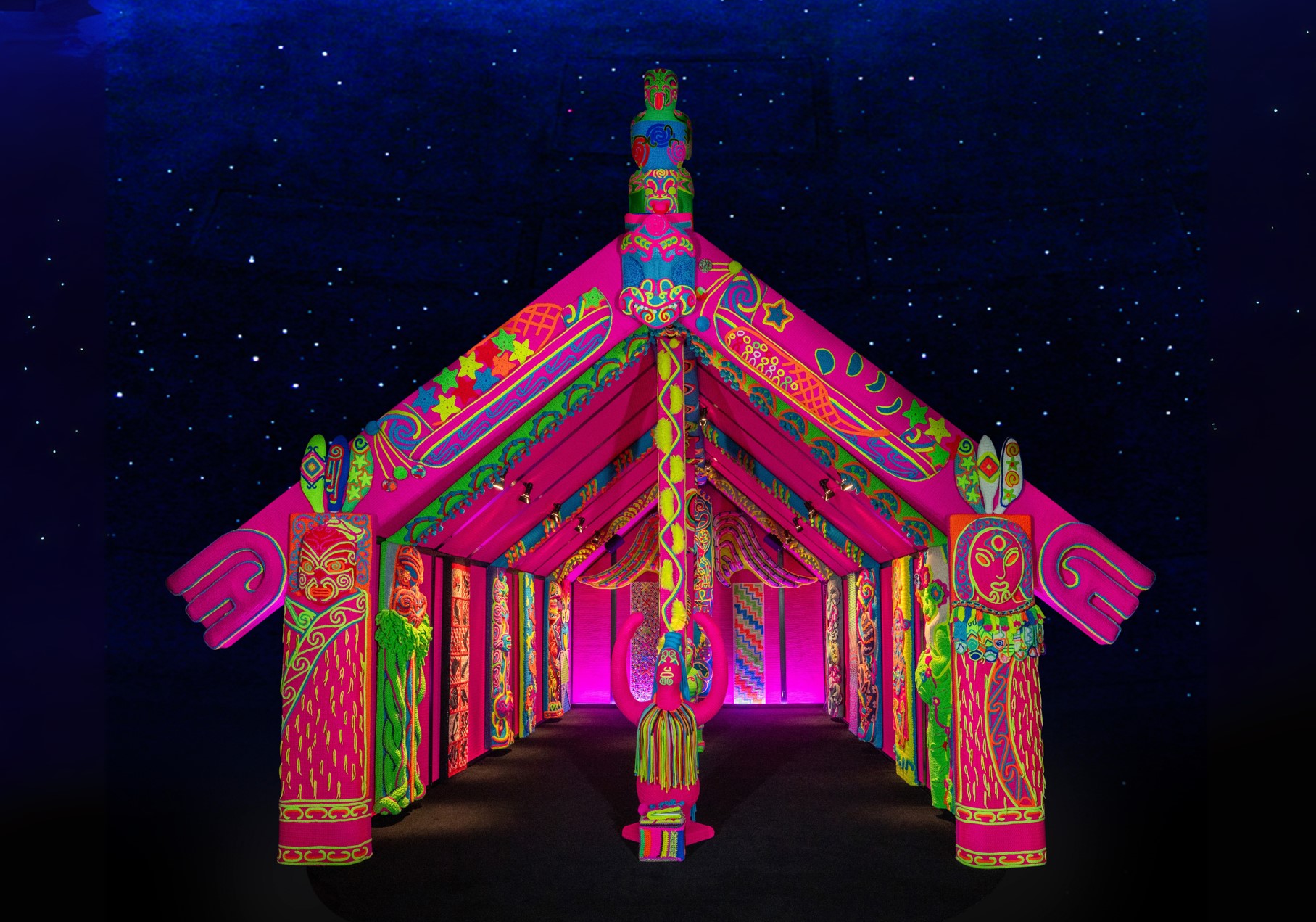
Wharenui Harikoa, which translates to ‘House of Joy’, is a contemporary wharenui (meeting house) handcrafted from vibrant crochet and created by 3D sculptural crochet artists Lissy and Rudi Robinson-Cole. The wharenui reimagines a traditional Māori meeting space through bright colour, texture and contemporary craft.
Handcrafted from thousands of crocheted elements and approximately 5,500 balls of yarn, Wharenui Harikoa is the first full-scale crocheted wharenui of its kind. Drawing on the cultural significance of the wharenui as a place of gathering, storytelling and belonging, the artists have transformed a traditional architectural form into a contemporary expression of aroha, resilience and collective wellbeing. The work is an immersive experience exploring healing, connection, whakapapa and the transformative power of joy or as Lissy says, “pure Indigenous joy”. Through Wharenui Harikoa, the artists have blended traditional form with contemporary materials, uplifting the spirit and celebrating cultural resilience.
First presented at Te Whare Taonga o Waikato Museum & Gallery before travelling to Canterbury Museum, Wharenui Harikoa has welcomed more than 170,000 visitors. Through colour, light and handcrafted detail, it invites people of all backgrounds to experience the power of Indigenous creativity, connection and joy.
Te Puia, Rotorua
In the geothermal heart of Rotorua, Te Puia is a must-visit cultural centre. It includes landmarks like the world famous Pōhutu geyser, along with mud pools, hot springs and a state-of-the-art kiwi conservation centre. It is also home to the New Zealand Māori Arts and Crafts Institute, and weaves environment and structure into a living cultural experience.
The architecture, including the award-winning Te Aronui a Rua wharenui, is a prime example of traditional Māori design continuing to innovate. Blending carved timber with contemporary materials, the buildings reflect deep respect for craft, whakapapa (lineage) and whenua (the land). It's a space of learning, tourism and creative practice, where carving, weaving and performance are shared with many varied audiences.
Taumata o Kupe - Te Mahurehure Marae, Point Chevalier, Auckland
Part of Te Mahurehure Marae in Point Chevalier, Taumata o Kupe is a striking cultural and event centre. It reflects how urban Māori architecture can honour ancestral legacy while embracing contemporary form. Designed by TOA Architects and completed in 2021, the building reinterprets traditional Māori architectural elements, like the steep gable of a wharenui (meeting house), with copper cladding, large glass panels and a modern spatial layout.
Named after the Polynesian navigator Kupe, Taumata o Kupe is a place for community gathering, learning and cultural celebration. The complex includes a wharekai (dining hall), marae ātea (formal forecourt) and flexible event spaces. The building has received national and international recognition, including being featured at the Venice Architecture Biennale and winning accolades from the New Zealand Institute of Architects.
Looking for spaces where architecture meets ancestry?
We know a place.
EXPLORE MORE
2.png)
